Political Relevance In Metal
1/16/20265 min read
Why I believe that political discourse was and always will be a part of Metal.
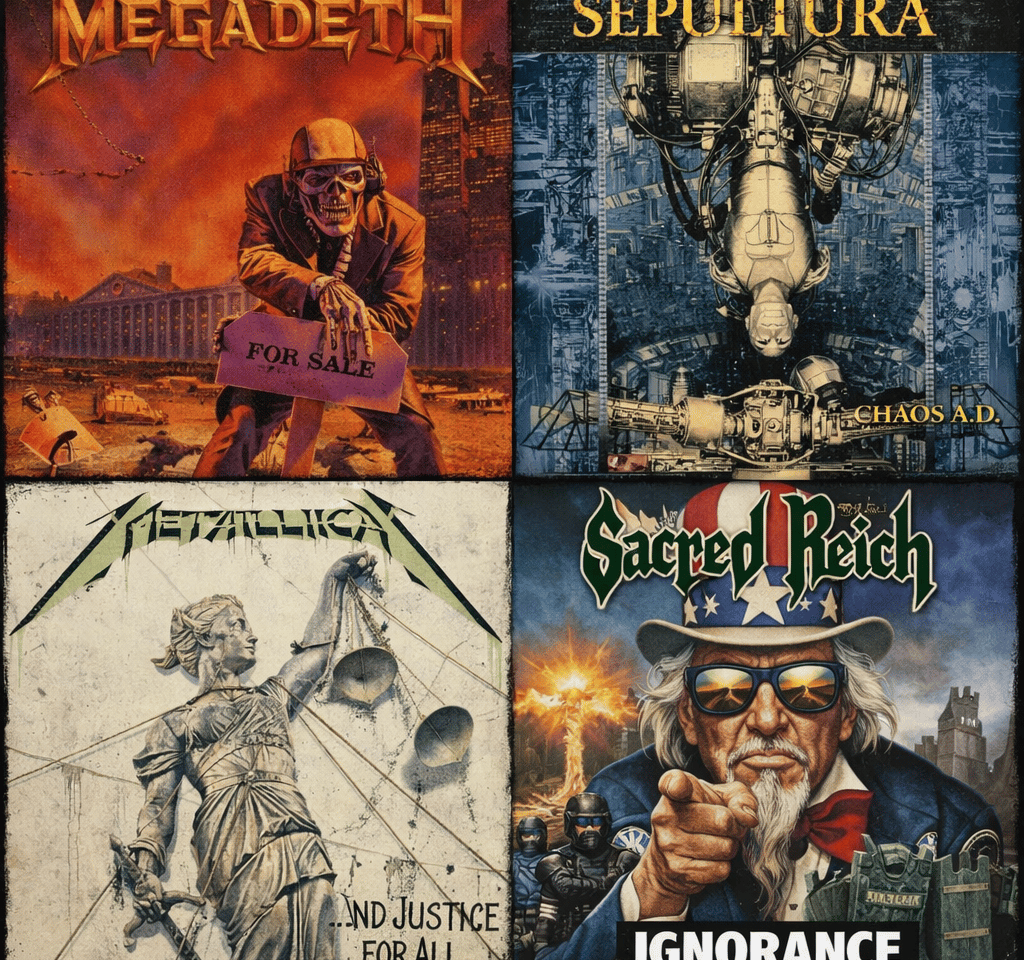
A young man sits in front of a television screen watching scenes depicting rioting, demonstrations and civil unrest. Intercut with footage of a band playing in front of a ferocious crowd, the music video to one of Megadeth’s most iconic songs, ‘’ Peace sells but whose buying’’, is interrupted by the boy’s father shouting at him to change the channel to the news. Replying that, ‘’this IS the news, he ignores the command, defiantly turns up the volume and continues watching. With lyrics such as, ‘’ if there’s a new way, I’ll be the first in line, but it better work this time’’, anthemic songs like the title track to Megadeth’s critically acclaimed second album were synonymous with the dissatisfaction felt by an increasingly disgruntled and angry generation.
Searching for meaning in a world dominated by the sensationalism, debauchery and corporate greed of Reagan era America, those wanting to challenge perceived perceptions and confront established rules soon found what they were looking for in the Metal scene of the eighties and nineties.
With its combination of Metals technical dexterity and the rawness of anti-establishment punk, the increasingly popular subgenre of Thrash Metal was at the forefront of this development. Due to its uncompromising critique of society and its willingness to stand in the face of adversity, it resonated with those wanting to break free of existing societal norms and dogmatic conservative structures. Feeling that the music had a way to articulate that which was affecting them as well as being an outlet through which they could express their grievances, those that felt marginalized by everyday society found that they could identify with the musical and lyrical content of artists that were not afraid to deconstruct perceptions, speak truth to power and address issues such as corruption, social and economic malpractice as well as other injustices.
With the emergence of the PMRC in 1985 and its advocacy for the introduction of Parental Advisory stickers on albums that were deemed to have a corrupting influence on the youth of the day, the rest of the Metal world was not far behind when it came to the perceived moral degradation of its listeners.
As time progressed however, not only did music that was previously considered to be transgressive become increasingly commercial but so too did the listeners reactions to, and engagement with, what they were hearing.
Whereas Metal previously had the ability to question the status quo and hold a mirror to society’s darker machinations, it had by now largely been assimilated into the mainstream where provocative, rebellious and challenging art had lost the ability to shock even the most conservative aspects of society.
Previously defined by its subversive nature as well as its ability to stand in opposition to a subjugated and brainwashed populace, music that previously opposed the establishment had become increasingly complacent and a part of the very poison that it once had the potential to be the antidote against.
While there were still bands from across a multitude of genres, particularly in the underground, that continued to address issues such as greed, corruption and other economic malpractices, there was also a clear shift towards mundane acceptance and blatant commercialism across the rest of the scene.
For a genre that was once accused of having a corrupting influence on youth and a disregard for authority, Metal had become increasingly assimilated and accepted into popular culture and reduced to mere entertainment,
Many that previously did not have a problem with a bands lyrical content, now thought that the artists were personally attacking their beliefs, trying to coerce them into advocating for a specific political action or forcibly trying to persuade them into a particular way of thinking if the lyrics did not fit their preconceived notions or personal point of view.
Perfectly incapsulated by the comment section of any website covering Metal, Hardcore or Punk, any time potentially polarizing lyrical content is addressed, an increasing number of disgruntled fans start to angrily debate the validity of religious or political themes within the content of the music.
With no room for nuanced discussion or tolerance for opposing views, a loud minority repeatedly take umbrage at bands for having the audacity to express views and opinions contrary to their own. Preferring instead that the music be used solely for the purpose of entertainment, they continuously suggest that there is no room in Metal for lyrical content that reflects the current state of the world, conveniently forgetting that bands like Black Sabbath, who are the arguable originators of the Metal genre, have been addressing such topics as far back as the late sixties and early seventies. Aptly demonstrated by War Pigs, the song was not only a commentary by the band on the futility of war but also a critique of those that choose to instigate conflicts in the name of profit and personal gain.
As the examples of Sabbath and the Thrash Metal movement clearly show, political or social commentary has always been a vital part of Metals storied history and while its popularity might have waned in recent years, it continues to push the boundaries both musically and lyrically.
This is particularly true in predominantly third world countries where there is either a strong totalitarian rule or a religiously conservative regime. In such areas it is not uncommon to be thrown in jail, tortured to death or killed for not conforming to the political ideologies of the ruling party or the dogmatic conservatism of the dominant religion.
This curtailing of personal freedoms, limitations of free speech and the disillusionment and hopelessness felt by many not only led to an increased Political and social awareness among the listeners but also the formation of bands whose lyrical themes and musical direction reflected the reality of the environments that they were living in.
Two prominent examples of this were Sepultura from Brazil or System of a down from America who used their Armenian roots to make music not only to honour their heritage but also as a reaction to the outright corruption and socio economic hardships of their respective countries as well as to address topics such as genocide, abuse of power, police brutality, the war on drugs or their discontent with nationalism and violence.
While entertainment and escapism are important with bands such as Municipal Waste or Steel Panther playing music that is purely geared toward enjoyment and escape, the few aforementioned examples show that Metal has not only always been a politically motivated form of music but that it continues to remain relevant.
With the current state of the world amidst pandemics, the continued rise and popularity of fascism and general division in politics among others, it feels like there has never been a more pertinent time for bands to address such issues as long as they do so in a non-preachy and non-condescending fashion or without trying to impose what some might consider to be controversial political or societal observations onto others.
As long as there are those disillusioned with their lives and the society that they live in, so too will there be music that is a reflection of what they are experiencing and as long as there are generations dissatisfied with their lives or oppressed by authoritative institutions of any kind so too will there be music that addresses it.
While there will always be those that will continue to argue at every opportunity that all music and the artists making it should remain silent, not address any topical issues or answer any questions pertaining to their art while promoting it, the irrefutable fact remains that not only has Metal always been political but that music in general and Metal in particular should always be able to challenge, inspire, act as a reflection of society and confront the listeners preconceived perceptions, no matter how often or how loud those that disagree argue to the contrary.