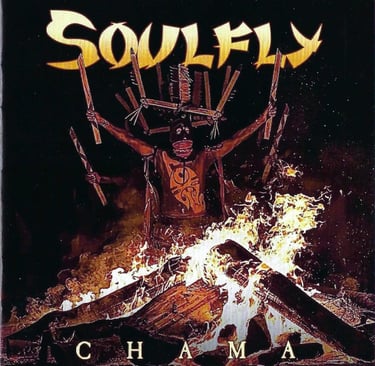
Soulfly’s latest album, Chama, presents an intriguing evolution, rather than simply a return to the primitive. While it doesn’t directly echo the band’s first two or three records in terms of sound, it does revisit the spirit of their beginnings more closely than on recent releases. The presence of elements from the band’s original concept is undeniable throughout Chama, yet such hallmarks have always existed across Soulfly’s discography, even within those albums that veered into thrash, death, or crust core territory. Thus, Chama is not so much a throwback, but more of a reset; it returns to the primitive in a literal sense, not by mimicking early albums, but through its rawness and unfinished character. Several tracks, to my ear, are less structured songs and more experimental sound collages, with the band pushing and expanding the boundaries of their core style.
Whether this direction is due to Cavalera’s son taking on a more prominent role or Max himself exploring new creative avenues, or a combination of both, the outcome is interesting in that some songs succeed better than others. While that is a statement true of most albums, it is not a flaw, as this variety adds to the album’s overall primal energy and atmosphere, occasionally reminiscent of Nailbomb’s Point Blank.
While some criticisms that ascertain that Chama consists of mere noise instead of actual songs are certainly an exaggeration, the album can feel convoluted at times, with its abundance of sounds and experimental touches making for an initially overwhelming listen. However, perseverance is rewarded, as repeated listens reveal hidden layers and details previously unnoticed. The fusion of various elements works especially well on No Pain, No Power, a track that blends Soulfly’s trademark style with shades of Fear Factory and Type O Negative. It’s haunting, somewhat progressive track, and, in my view, one of Max’s finest compositions within the Soulfly framework.
While Chama is purported to reconnect with the roots of Soulfly, in that it incorporates more traditional Brazilian tribal elements than previous releases, it feels like a hybrid, merging the hardcore energy of Roots with the noise and industrial influences of Nailbomb. This is all set atop Soulfly’s recognisable mix of groove, death, and industrial metal, spiced with a hint of noise rock. Lyrically, Max’s familiar social disgust remains, but this time his ire seems especially sharp as he hasn’t sounded so unhinged in years. Nihilist exemplifies this newfound ferocity, which along with Storm the Gates, comes closest to recapturing the spirit of Soulfly’s earliest albums. Yet, even here, the sound is harsher, with industrial production and rhythmic stop-start moments adding further grit.
While to me Dark Days remains the pinnacle of Soulfly’s output, Max’s relentless drive to propel the band’s music forward is something to be admired and while not all songs on Chama work in my opinion, his refusal to compromise and his infectious enthusiasm continue to embody metal’s enduring vitality.